


 03 9070 5784
 Help & Support
 Track My Order



Recently Viewed


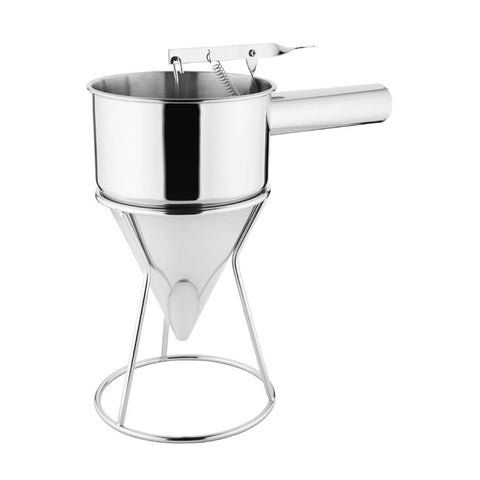

 Vogue Stainless Steel Piston Funnel 1.3Ltr - GG759
135(W) x 210(H) x 135(D)mm

 Vogue Plastic Funnel 150mm - K508
150(W) x 145(H) x 150(D)mm

 Carlisle Measure Miser Forest Green Measuring solid spoon with long handle 120mL Capacity - Pack of 12 - Pack Price - 398008
 Carlisle Measure Miser Beige Measuring solid spoon with short handle 150mL Capacity - Pack of 12 - Pack Price - 493306
 Carlisle Measure Miser Blue Measuring solid spoon with short handle 240mL Capacity - Pack of 12 - Pack Price - 493114
 Carlisle Measure Miser Black Measuring Perforated spoon with long handle 180mL Capacity - Pack of 12 - Pack Price - 399103

 Carlisle Measure Miser Orange Measuring solid spoon with short handle 60mL Capacity - Pack of 12 - Pack Price - 492524
 Carlisle Measure Miser Beige Measuring Perforated spoon with short handle 150mL Capacity - Pack of 12 - Pack Price - 496606
 Carlisle Measure Miser Red Measuring solid spoon with long handle 60mL Capacity - Pack of 12 - Pack Price - 396005
 Carlisle Measure Miser White Measuring solid spoon with long handle 90mL Capacity - Pack of 12 - Pack Price - 397002
 Carlisle Measure Miser Forest Green Measuring solid spoon with short handle 120mL Capacity - Pack of 12 - Pack Price - 492808
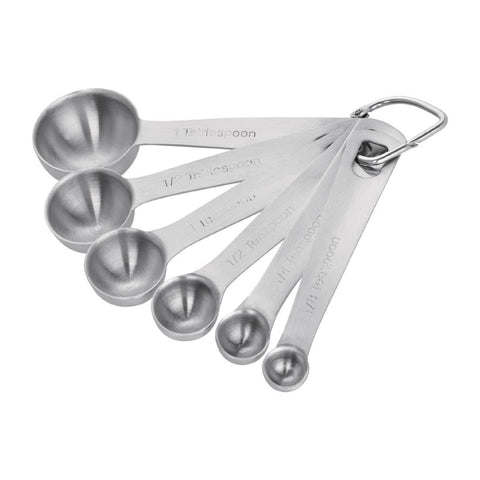
Measuring spoons and cups are how a batch comes out the same on a Tuesday as it did on Saturday, whoever is on prep: scoop, level, in it goes. A set of stainless measuring spoons and a nested set of measuring cups covers almost all the dry and small-volume wet measuring done on a prep bench.
What separates a commercial measuring cup set from a supermarket one is how long the markings last and how well it is put together. Stamped or etched graduations survive the dishwasher; printed ones do not. A welded or riveted handle outlasts a crimped one, and a flat rim lets you level a dry measure with a straight edge instead of guessing.
Measuring sets sit in the kitchen utensils range beside measuring jugs and kitchen scales, and they are used with mixing bowls and mixing paddles.
Working out a set for each station? The price guide has the cups, spoons and jugs priced in the one list.
Weigh anything where the result depends on the ratio — flour, sugar, yeast, salt, raising agents. A cup of flour varies with how it was scooped, and that variation is what makes one batch of pastry different from the next.
Volume measures are right for small quantities, liquids and anything a recipe is already written in. Keep both: a set of cups and spoons for speed, and a kitchen scale for accuracy.
A dry measure is filled to the rim and levelled off with a straight edge, which is why dry measuring cups have no spout and no headroom. A liquid measure has headroom and graduations up the side so you can read the level without spilling.
Using one for the other is a reliable way to be slightly wrong every time. A measuring jug is the liquid tool; the cups in a nested set are the dry one.
Stainless handles heat, will not stain from turmeric or tomato, and keeps its shape if someone stands a hot pan on it. It is the default for a working prep bench. 304 stainless steel is the food-safety grade used in Australian commercial kitchens.
Plastic is lighter, cheaper to replace and often clearer to read for liquids. It also scratches, absorbs colour and goes brittle with repeated hot washes. The plastic kitchen accessories and stainless steel kitchen accessories ranges cover both.
Keep them on the ring they came on, and hang the ring rather than dropping it in a drawer. A set loose in a drawer loses its smallest spoon within a month, and the smallest spoon is the one that matters most.
Buy two sets for any station that uses them constantly, so one can be in the wash. Hold them in a cutlery storage tray or a labelled container from the kitchen storage boxes range.
The names are standard; the actual volumes have small variations between makers, and Australian, US and metric cup sizes are not the same. Mixing sets from different makers inside one recipe is where the drift comes from.
Standardise on one set per station and keep the measures that came together, together. If a recipe matters enough to be exact, check the stated volume on the product page specifications and weigh the critical ingredients.
Stainless sets generally do. Plastic sets depend on the material, so check the rating on the product page before anyone puts them through a hot cycle, because repeated high-temperature washes fade printed markings.
Markings that have worn off are the real reason a set gets retired. A commercial dishwasher is fast but hard on print; hand washing a printed plastic set is worth the minute.
One nested set of dry measuring cups, one set of measuring spoons, one mid-sized liquid jug and a scale. That covers nearly everything, and it is cheaper than the single-use gadgets it replaces.
Add duplicates of whatever gets used every service. The rest of the kitchen tools range covers the timers, scoops and scales that go with them.

We have a special page just for stock that's warehoused in Perth.
Click Here to see all WA stockWhat our customers say about us on Google, and how Google scores our store for things like shipping and returns.
Store scores from Google