


 03 9070 5784
 Help & Support
 Track My Order



Recently Viewed
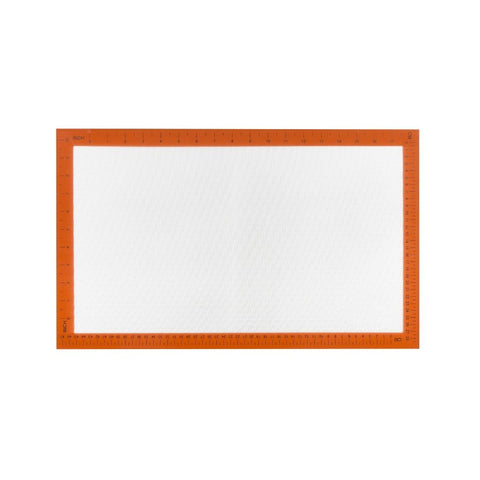


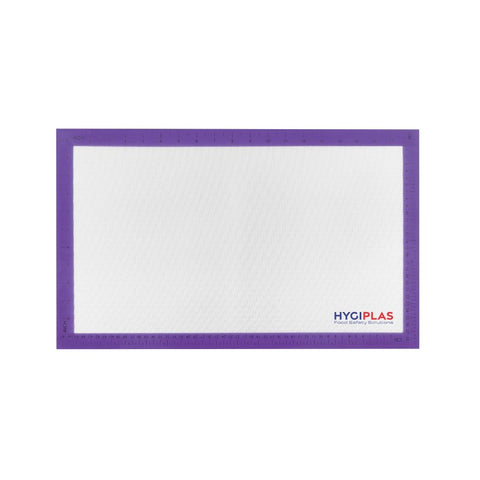

 Hygiplas Allergens Non-Stick Baking Mat 520x315mm - FB608
315(W) x 520(H) x 1(D)mm
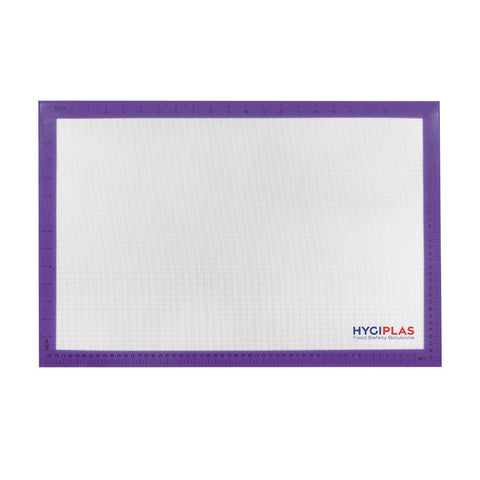
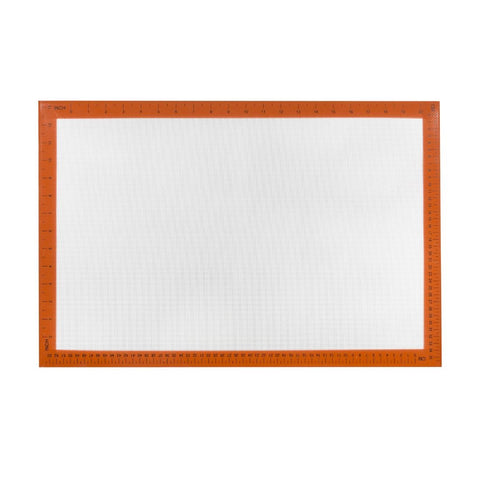
 Hygiplas Allergens Non-Stick Baking Mat 585x385mm - FB609
385(W) x 585(H) x 1(D)mm
A professional baking mat is a reusable liner that sits in a tray and gives you a non-stick surface without baking paper. Commercial baking mats produce a more even base than paper, because they sit flat and stay flat.
They are used for biscuits, macarons, pastry, bread rolls and anything else that would otherwise stick or need greasing. Perforated versions let air through to the base, which is what you want for bread and choux coming out of a baking oven.
Mats are sized to standard trays, so check what your oven takes before ordering. See commercial baking trays and the wider bakery accessories range.
Lining every tray in a bakery means mats in more than one size. get a quote and we will work out how many of each you need.
Most are silicone, often reinforced with a glass-fibre mesh that keeps them flat and stops them stretching. Some are a coated fabric instead. Both are designed to release without grease and to go back in the oven hundreds of times.
What matters when comparing them is the stated temperature range and whether the mat is rated for food contact. Both are listed on the product page.
For most work, yes, and a busy bakery gets through a lot of paper in a year. The mat also gives a more consistent result, because it does not crease, lift or move when a tray is slid into the oven.
Where paper still wins is one-off jobs, anything you want to lift the product out on, and products that are going to be wrapped straight off the tray.
Perforated mats let air and steam through to the base of the product, which gives a crisper bottom on bread rolls, choux and some pastry. They are usually used with a perforated tray so the airflow has somewhere to go.
A plain mat is better for anything runny, for biscuit and macaron work, and for products you want a flat, even base on. Many bakeries keep both and match the mat to the product, along with baking trays in each style.
Wash in warm water with a mild detergent, rinse and dry flat. Most are rated for a commercial dishwasher, but check the manufacturer's instructions, and never scour one — an abrasive pad is what ruins the release surface.
Store flat or loosely rolled, never folded, because a crease becomes permanent and the product will sit unevenly over it. A racking trolley with empty trays is a practical place to keep them. Keep them away from knives and anything that could cut the surface.
Hundreds of bakes if it is treated properly, and far fewer if it is cut, scoured or folded. The usual end of life is the release surface wearing or the edges fraying, not the mat failing outright.
Treat them as a consumable with a long life, in the same way as dough scrapers and pastry brushes. Replace one once product starts sticking, because a mat you have to grease is no longer doing its job.
Only where the manufacturer says so. Cutting a mesh-reinforced mat exposes the mesh and the edge will fray, so the better answer is to buy the size that fits.
Measure the internal dimensions of your trays first. If you are working with unusual tray sizes, the pastry and baking supplies range and the rest of our bakery equipment collection are worth a look.

We have a special page just for stock that's warehoused in Perth.
Click Here to see all WA stockWhat our customers say about us on Google, and how Google scores our store for things like shipping and returns.
Store scores from Google
