


 03 9070 5784
 Help & Support
 Track My Order



Recently Viewed

 Mecnosud Forked Mixer 25kg - SMF0025
870(W) x 890(H) x 560(D)mm
 Mecnosud Forked Mixer 35kg - SMF0035
885(W) x 890(H) x 590(D)mm
 Mecnosud Forked Mixer 80kg - SMF0080
1025(W) x 1110(H) x 744(D)mm
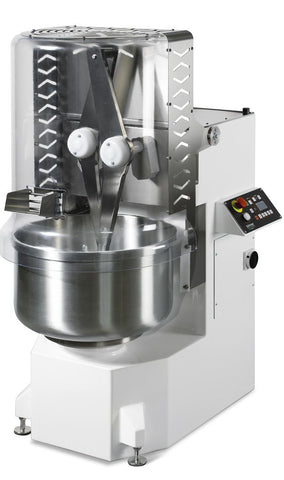
 Italmixer Twin Arm Mixer with Manual Control - 2-Speed - 81L - iTWIN55 MAN
690(W) x 1013(D) x 1416(H)mm
Italmixer Twin Arm Mixer with Manual Control - 2-Speed - 92L - iTWIN65 MAN
690(W) x 1013(D) x 1416(H)mm
Italmixer Twin Arm Mixer with Touch Control - 5-Speed - 81L - iTWIN55 TOUCH/1PH
690(W) x 1013(D) x 1416(H)mm
Italmixer Twin Arm Mixer with Touch Control - 5-Speed - 92L - iTWIN65 TOUCH/1PH
690(W) x 1013(D) x 1416(H)mm
Italmixer Twin Arm Mixer with Touch Control - 5-Speed - 70L - iTWIN45 TOUCH/1PH
690(W) x 1013(D) x 1416(H)mm
Italmixer Twin Arm Mixer with Manual Control - 2-Speed - 70L - iTWIN45 MAN
690(W) x 1013(D) x 1416(H)mm
A commercial fork mixer is the machine for wet, slow-fermented dough: Neapolitan pizza bases and rustic bread, where the hydration is high and the dough is left to develop over hours rather than minutes. A hinged fork sweeps through a turning bowl, lifting and folding the dough rather than dragging it round, so very little friction and very little heat go into the mix.
For faster, stiffer production work a spiral mixer is the usual pick, and a planetary mixer covers general kitchen mixing.
Fork machines are part of the wider commercial mixers range within our bakery equipment collection.
Silverchef Rent-Try-Buy can fund a fork mixer now, with the option to upgrade or hand it back as things change.
The tool and the speed. On a spiral machine the bowl turns under a fixed spiral hook, which works the dough firmly and develops the gluten quickly. A fork swings through on a hinge, opening the dough up and folding it over, and takes longer to reach the same development.
The practical difference is heat and handling. A fork machine adds very little temperature to the dough, so a long ferment stays under control, and it treats a slack dough gently enough that it holds its structure.
For high-hydration Neapolitan-style dough, it is the machine many pizzaioli specifically ask for. The gentle action suits a dough that is going to sit for a long rise and then be opened by hand.
For a high-volume pizza shop pressing bases to order, shaping speed matters more than mix style, and a dough roller or dough divider will do more for the service than the mixer choice does.
Not well, and that is the trade-off. A fork is designed to move soft dough. Stiff, low-hydration dough resists it, and the machine has no equivalent of a paddle or a whisk, so it does nothing for batter, cream or icing.
Kitchens that need both usually run a fork machine for bread and pizza and a counter top mixer for everything else.
Longer than a spiral machine, by design. The dough comes together, then opens up, then tightens as gluten develops, and you judge it by look and feel rather than by the clock.
That slow working is the point rather than a drawback. Because so little friction goes in, you have a wider window before the dough overheats, which is what you want on a hot kitchen day.
Floor space and a solid, level spot — these are freestanding machines and the bowl has to turn true. Allow room to stand beside it and to get a tub of dough in and out without reaching over the bowl.
The electrical requirement is on each product page; larger machines are commonly three phase. Have the supply confirmed before delivery, and we can arrange installation and the connection through our installation partners.
Clean the bowl, the fork and the bowl rim after each use, before the dough dries on. Keep flour out of the moving parts, and check the guard interlock works, since that is what stops the machine when the lid is lifted.
A worn part does not mean a new machine. Request what you need through the spare parts page.

We have a special page just for stock that's warehoused in Perth.
Click Here to see all WA stockWhat our customers say about us on Google, and how Google scores our store for things like shipping and returns.
Store scores from Google