


 03 9070 5784
 Help & Support
 Track My Order



Recently Viewed


 Vogue Japanese Mandoline - D445
90(W) x 305(H) x 25(D)mm

 Vogue Jumbo Japanese Mandoline - CC052
132(W) x 347(H) x 26(D)mm
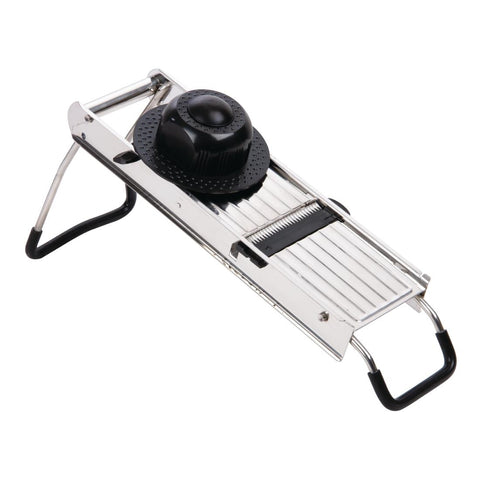
 Vogue Mandoline - Y836
135(W) x 20(H) x 400(D)mm

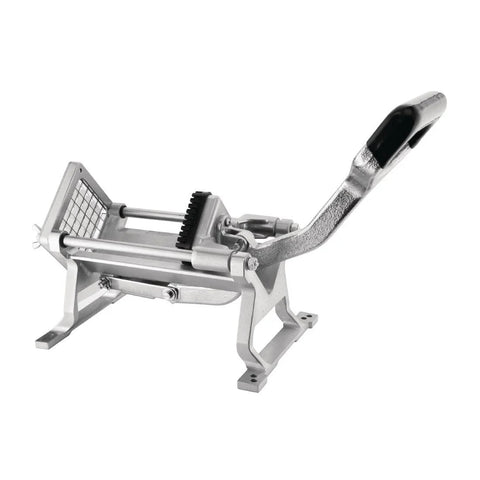
 Vogue Potato Chip Cutter - DB344
204(W) x 290(H) x 436(D)mm
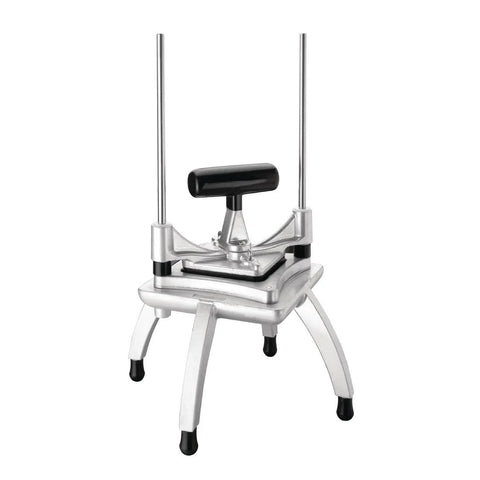
 Vogue Vegetable Dicer with 9.5mm blade - DB345
253(W) x 470(H) x 253(D)mm
A commercial mandoline is a fixed blade in a frame that you pass product across, and it produces a thinner, more even slice than a knife in anybody's hands. In a kitchen that plates fennel, radish, potato or citrus, a restaurant mandoline slicer is the difference between a garnish that looks considered and one that does not.
A restaurant quality mandoline slicer holds its setting through a full prep session instead of drifting, comes with a guard that staff will actually use, and can be taken apart and washed properly. That is what separates a trade mandoline from a domestic one.
They sit in the manual kitchen appliance range alongside manual tomato slicers and manual veg prep machines. Where the volume outgrows hand work, a veg processor or a food processor takes over.
Buying several for a brigade, or kitting out a new kitchen? Send us the list and get a quote.
Evenness and speed on thin cuts you make over and over. A fixed blade at a set height produces identical slices from the first one to the hundredth, and that matters for anything cooked or plated as a stack, where one thick slice ruins the result.
For a handful of slices a sharp knife is faster, because there is nothing to set up or wash. The mandoline wins the moment you are doing the same cut twenty times.
The blade is fixed, exposed and extremely sharp, and the hand is what moves across it, so a mandoline needs treating with the same respect as a knife. Nearly every cut comes from the guard being left in the drawer.
Use the guard or a cut-resistant glove every time, stop while there is still a usable piece of product rather than working to the last slice, and never pass one down the bench blade-up. Our kitchen glove range covers the protective options.
A straight blade for plain slices plus julienne combs are the two that earn their place in most kitchens. Waffle and crimped blades look impressive and get used rarely, so buy them only if a dish on your menu needs them.
Check how the blades are changed and whether they are available separately for the model, because a mandoline with an unobtainable replacement blade has a short working life. Blade and accessory details are listed per product.
Stainless frames are more rigid, which keeps the cut consistent, and they handle a commercial wash cycle indefinitely. 304 stainless steel is the food-safety grade used in Australian kitchens and it is what you want on anything that touches food.
Polycarbonate bodies are lighter and cheaper and perfectly serviceable for lower volumes, but they flex and they scratch. If the mandoline is going to live on a stainless steel bench and be used every day, buy the metal one.
Apart, immediately, and never left soaking in a sink where somebody will reach into it. Most trade models break down to a frame, a blade and a guard, and all three go through the wash and get dried before reassembly.
Store it with the blade covered or the unit folded, in a dedicated spot rather than loose in a drawer. Treat it the way you treat your knives: on a rack or in a case, not in with the utensils.
When the volume stops being a person's job. If someone is spending an hour or two every morning on one cut, a powered machine does it faster and more safely, and that is the whole argument.
Our veg prep machine range and the cutter discs that go with it cover the same cuts at volume, and a chopping board and knife still cover the one-off jobs. If you want help comparing the two, send your prep list through and get a quote.

We have a special page just for stock that's warehoused in Perth.
Click Here to see all WA stockWhat our customers say about us on Google, and how Google scores our store for things like shipping and returns.
Store scores from Google