


 03 9070 5784
 Help & Support
 Track My Order



Recently Viewed

 Nemco Easy Tomato Slicer 4.5mm - NTS0045
360(W) x 170(H) x 160(D)mm

 Tre Spade Electric Tomato Squeezer - TSE0004
330(W) x 300(H) x 580(D)mm
 Nemco Easy Scooper Tomato Corer - NTS55875
N/A(W) x N/A(H) x N/A(D)mm
 Nemco Easy Tomato 6.25mm - NTS0060
360(W) x 170(H) x 160(D)mm
 Tre Spade Tomato Squeezer Attachment - TSE1004
280(W) x 340(H) x 365(D)mm
 Nemco Easy Tomato Slicer 2 4.5mm - NTS1045
190(W) x 238(H) x 467(D)mm
 Nemco Easy Tomato Slicer 2 6mm - NTS1060
190(W) x 238(H) x 467(D)mm

 Prince Castle Tomato Core-it Bulk Pack (Box of 144) - 950-1
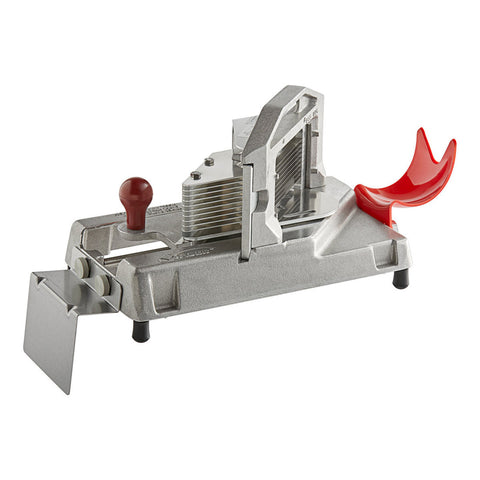
 Prince Castle Tomato Saber 6.3mm Slice (9 blades) - 943-B
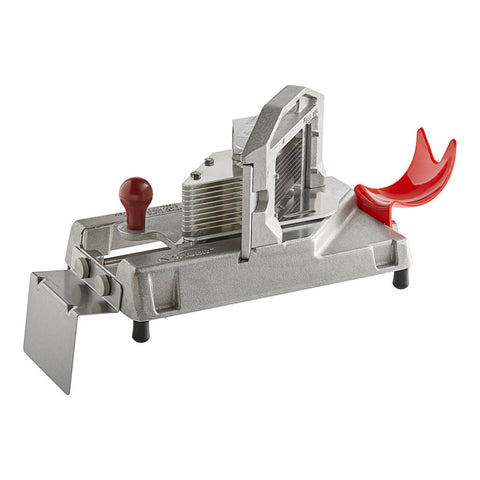
 Prince Castle Tomato Saber 4.7mm Slice (12 blades) - 943-A
A hand tomato slicer is a hinged frame of parallel blades that cuts a whole tomato into even slices in one push. On a sandwich, burger or salad line a manual tomato slicer replaces the slowest and least consistent knife job in the kitchen, and every slice comes out the same thickness.
Commercial manual tomato slicers come in different blade spacings, because a burger slice and a salad slice are not the same thickness, and in different frame sizes for different fruit. Blade spacing is the specification that matters; everything else is build quality.
They sit in the manual kitchen appliance range beside mandolines and manual veg prep machines, with powered options in our veg processor range.
Kitting out a burger line or several stores at once? Send us the counts and get a quote.
Dramatically, and more importantly it is consistent. One push gives a whole tomato in even slices with no thin ends and no wedge-shaped offcuts, which is what a knife produces when a cook is working at speed.
The gain is biggest where tomato goes on every item. A burger line building hundreds of serves gets both the speed and the portion control; a restaurant slicing a few tomatoes a service will not notice.
Thicker spacing for burgers, where the slice has to survive being stacked and has to be tasted against the patty. Thinner spacing for sandwiches and salads, where a thick slice makes the item unwieldy and slides out.
If you run both, a second slicer is cheaper than compromising on one spacing. Each product page lists the spacing for that model, so match it to the item rather than buying the mid-point.
Soft, round product of a similar size: boiled eggs, mozzarella balls, mushrooms, kiwifruit and small onions all work in most frames. Hard product will not go through, and anything much larger than the frame will jam.
Dedicated tools do each of those better if the volume justifies it. For firmer vegetables, a mandoline or a cutter disc on a powered machine is the right answer.
Wash and dry the blade assembly after every use and keep it away from acid residue, because tomato juice left on steel overnight marks it. A slicer that is pushing rather than cutting has either blunt blades or a bent one.
Confirm replacement blade sets are available for the model before you buy. Blades are the consumable on these units and a slicer with no spares available is a short-term purchase.
A sharp slicer on a properly ripe tomato does not, but an overripe one will lose juice however it is cut. The usual culprit when slices come out crushed is a blunt blade set or product that was too soft to be sliced at all.
Keep tomatoes at the right firmness and bring them out of refrigeration shortly before the prep session, not days before. A countertop prep fridge at the make line keeps the sliced product cold without over-chilling the whole stock.
At the start of the build, with the whole fruit on one side and a container for the slices on the other, and bolted or set on a surface that will not move. These units need a firm push, and a slicer that slides is a hazard.
Slices go straight into a chilled insert rather than onto a board. Keep a chopping board and a knife nearby for the ends and the odd shapes, and the rest of the burger shop range covers what sits either side of it.

We have a special page just for stock that's warehoused in Perth.
Click Here to see all WA stockWhat our customers say about us on Google, and how Google scores our store for things like shipping and returns.
Store scores from Google