


 03 9070 5784
 Help & Support
 Track My Order



Recently Viewed
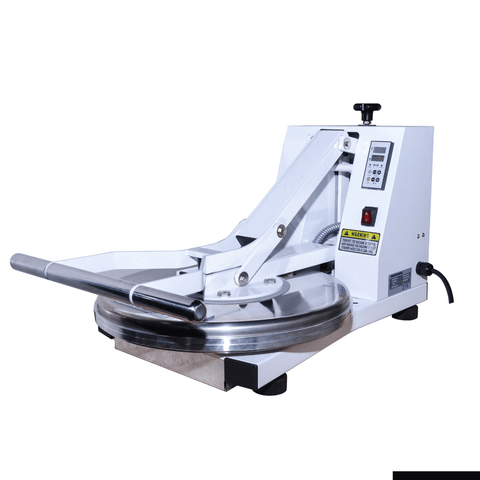

 Tyrone Tyron Round Dough Press – DP-18S
470(W) x 470(D) x 765(H)mm
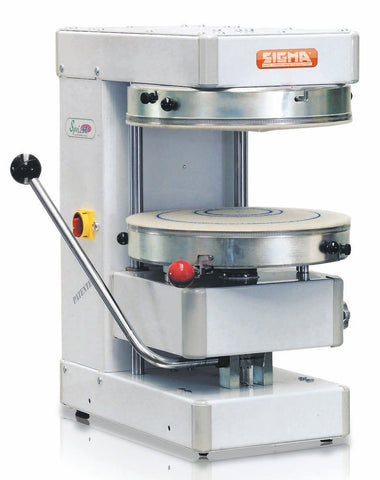

 Sigma Sprizza Manual Pizza Cold Press Machine - Up to 400 pizza/hr - SPZ40
570(W) x 720(D) x 770(H)mm
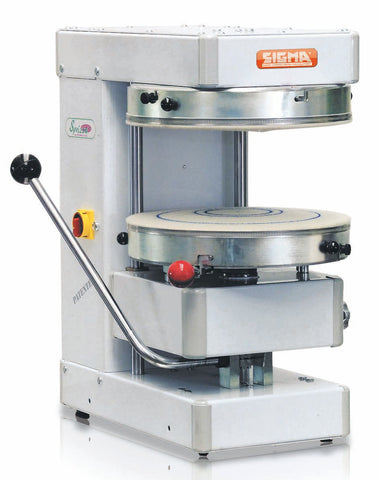 Sigma Sprizza Manual Pizza Cold Press Machine - Up to 500 pizza/hr - SPZ50
700(W) x 820(D) x 840(H)mm

 Prismafood Pizza shaping machine - PRA33
470(W) x 590(D) x 830(H)mm
A pizza former presses a dough ball into a finished base in one movement, so the base comes out the same size and the same thickness every time regardless of who is on shift. The venue range it belongs to is pizza shop equipment.
Commercial pizza formers come as hot-plate presses, which apply heat as well as pressure, and cold presses, which only apply pressure. The heated type sets the base and part-cooks the surface, which makes it faster to handle and changes how the dough behaves in the oven. The product page states which type a model is.
It sits between the dough and the oven. Upstream is the mixing and dividing — commercial floor mixers, commercial dough dividers and commercial dough rounders. Downstream is commercial pizza deck ovens.
Sometimes written as one word, a "pizzaformer" is the same machine. Whether it suits your dough is worth a conversation rather than a guess, so tell us your dough, your base sizes and your volume and request a callback.
It takes a weighed dough ball and presses it flat to a set diameter and thickness between two plates. The operator loads, closes, opens and lifts out a base. What used to be a skill becomes a repeatable step, which is the point in a shop with casual staff.
It does not replace the dough. A former presses what you give it, so the weight and the proof of the ball still decide what comes out. Weighing the balls consistently is what makes the machine look good.
A former presses the ball flat in one action between two plates. A dough roller passes the dough through rollers and produces an even sheet, which suits a thin, uniform base and pastry work.
If the product is thin, flat and uniform edge to edge, the roller is closer to it. For a Neapolitan base with a puffed rim, opening the dough by hand is still the method, because a roller presses the gas out of the edge as well as the centre. Shops running more than one style sometimes have both.
A heated press sets the surface of the base, so it holds its shape, is easier to move and goes into the oven part-stabilised. That is the usual choice for a shop making bases ahead of service.
A cold press leaves the dough fully raw, which keeps more of the texture and suits doughs that are proved and baked soon after pressing. The heated option changes the finished crumb, so it is worth trialling with your own dough before committing.
Within the range the machine is built for, and the way it is adjusted differs between models. Some change the plate gap for thickness while the diameter is fixed by the plate; others take a plate change. The product page states what is adjustable.
If you sell two or three base sizes, confirm before buying that one machine covers all of them — otherwise the result is two machines or one size pressed and the others made by hand.
It depends on how many bases you make and who makes them. A shop with an experienced pizza maker turning out fifty bases a night gains little. A shop with rotating casual staff making two hundred gains consistency, speed and less waste from torn bases.
Run the numbers on labour and on rejected bases before the price of the machine. If the volume is not there yet, the money usually goes further on the oven and the commercial pizza prep fridges first.
Plates get scraped and wiped down while they are still warm but isolated from power, and flour and dough are cleared from the body and the hinge every day. Dough left to set on a plate is what wrecks the finish and the next hundred bases.
Follow the manufacturer's instructions on the plate surface, because an abrasive or the wrong cleaner can take the coating off. The general cleaning range is cooking equipment cleaners.
Between the dough store and the make-up bench, so the operator takes a ball, presses it and puts the base straight onto a tray or the bench. Any walking in that sequence undoes the time the machine saves.
Leave bench space on both sides and somewhere to stack pressed bases — usually commercial pizza trays on a rack. The benching is commercial stainless steel kitchen bench, and pizza utensils covers the handling.

We have a special page just for stock that's warehoused in Perth.
Click Here to see all WA stockWhat our customers say about us on Google, and how Google scores our store for things like shipping and returns.
Store scores from Google