


 03 9070 5784
 Help & Support
 Track My Order



Recently Viewed

 Vogue Polycarbonate Food Storage Container 18Ltr - CG985
456(W) x 229(H) x 305(D)mm
 Vogue Polycarbonate Food Storage Container 45Ltr - CG987
660(W) x 230(H) x 460(D)mm
 Vogue Polycarbonate Food Storage Container 30Ltr - CG986
150(W) x 660(H) x 460(D)mm
 Vogue Polycarbonate Lid Small - CG988
456(W) x 30(H) x 305(D)mm

 Vogue Polycarbonate Lid Large - CG989
660(W) x 30(H) x 460(D)mm
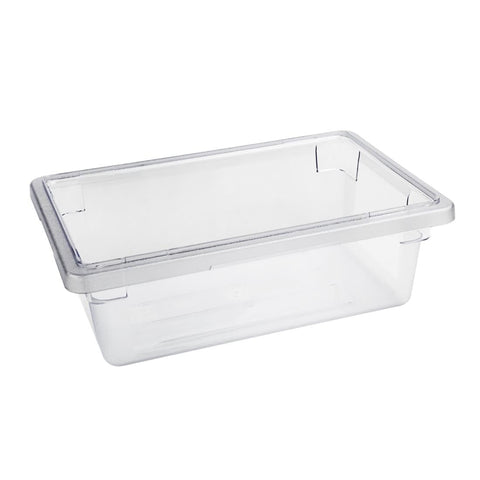
 Vogue Polycarbonate Food Storage Container 12Ltr - CG984
456(W) x 155(H) x 305(D)mm
Plastic kitchen accessories do the jobs where weight, cost and visibility beat durability: storage, decanting, portioning, scooping and anything that has to be seen through. Commercial plastic kitchen accessories are light enough to lift full and cheap enough to replace on a schedule rather than nursing along.
The buying decision is material, not shape. Polycarbonate is the clear one; polypropylene is tougher and cheaper but cloudy; polyethylene is the soft, chemical-resistant one used for boards and bins. Each stains, scratches and ages differently, and that is what decides how long an item lasts on your bench.
They sit opposite the stainless steel kitchen accessories range and overlap with food storage, gastronorms and containers and ingredient bins.
Standardising on one container family so the lids interchange? The price guide lists the containers, bins, jugs and scoops together, so you can see which sizes share a lid.
Anywhere you need to see the contents, lift it full without a second person, or accept that it will be replaced. Clear storage containers, measuring jugs for liquids, ingredient bins and scoops are all better in plastic.
Stainless wins on the hot side, under knives and anywhere acidic product sits for hours. The stainless steel kitchen accessories range covers that end.
Clear items are usually polycarbonate, which is strong and stands a commercial wash but can cloud and craze over time. Cloudy, flexible items are usually polypropylene or polyethylene, which are tougher against knocks and chemicals but hide what is inside.
Material and temperature ratings are item-specific. Take them from the product page specifications rather than assuming all clear containers behave the same way.
Wash cool enough and often enough. Clouding and crazing come from repeated very hot cycles and from caustic detergent sitting on the surface, not from age. Turmeric, tomato and beetroot stain anything porous no matter how quickly you wash.
Dedicate a few containers to the heavy-staining ingredients and let them look used. Rinse before they go into the commercial dishwasher so you are not baking residue on.
Only where the item is rated for it. Pouring hot stock into a container not rated for it softens the wall and can deform the base, which is how a full container fails on a shelf.
For hot transfer and holding, use stainless or a rated insulated food carrier. Decant into plastic once the product is through the cooling step.
Treat them as consumables with a visible retirement test: a container with a crack, a deep knife score or markings you can no longer read is finished, regardless of how old it is.
Cracks and scores hold bacteria and are not cleanable. Keep enough spares that nobody has to keep using a damaged one, and order replacements as a line item rather than an emergency.
Polyethylene boards are the commercial default because they can be colour-coded, go through a machine wash and be replaced cheaply once they are scored. Timber boards are kinder to a knife edge and look better, but they cannot go through a machine, which is why they stay front of house.
Replace a plastic board once it is deeply scored rather than planing or sanding it. The chopping board range covers the sizes and colours.
Clear storage containers with matching lids in two or three sizes, ingredient bins for flour and sugar, a set of scoops, a couple of jugs and colour-coded boards. That list covers most of the first week.
Standardise on one container family so the lids interchange. Mixed lids are the single most common source of lost time in a dry store; the kitchen storage boxes and kitchen food labels ranges finish the job.

We have a special page just for stock that's warehoused in Perth.
Click Here to see all WA stockWhat our customers say about us on Google, and how Google scores our store for things like shipping and returns.
Store scores from Google