


 03 9070 5784
 Help & Support
 Track My Order



Recently Viewed

 Bonvue Trolley For Countertop Bain Marie BMT14
1400(W) x 630(D) x 750(H)mm


 Roband Food Bar and Bain Marie Trolley, 8 pans size - ET24
1325(W) X 585(D) X 670(H)mm

 Roband stainless steel panels to suit "ET26" trolley - ETP26

 Roband Food Bar and Bain Marie Trolley, 12 pans size - ET26
1975(W) X 585(D) X 670(H)mm

 Roband stainless steel panels to suit "ET24" trolley - ETP24
 Bonvue Trolley for Countertop Bain Marie BMT17
1750(W) x 630(D) x 750(H)mm

 Roband stainless steel panels to suit "ET23" trolley - ETP23

 Roband Food Bar and Bain Marie Trolley, 10 pans size - ET25
1650(W) X 585(D) X 670(H)mm

 Roband stainless steel panels to suit "ET25" trolley - ETP25

 Roband Food Bar and Bain Marie Trolley, 6 pans size - ET23
1000(W) X 585(D) X 670(H)mm

 Roband Food Bar and Bain Marie Trolley, 4 pans size - ET22
675(W) X 585(D) X 670(H)mm
 Bonvue Trolley for Countertop Bain Marie BMT11
1060(W) x 630(D) x 750(H)mm
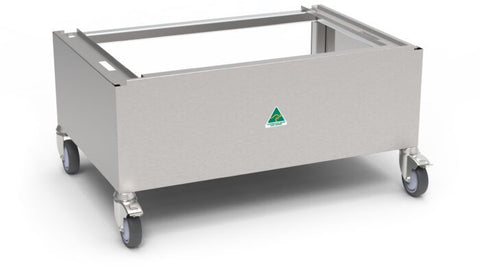
 H200 Trolley CL-HT200
899(W) X 598(D) X 429(H)mm

 Roband stainless steel panels to suit "ET22" trolley - ETP22
A bain marie trolley is a heated bain marie on castors, so hot food is held at temperature on the way from the kitchen to where it is served. Where that distance is a corridor, a function room or another floor, food plated in the kitchen arrives cold unless it travels in something heated. A bain marie hostess trolley is the same thing under the name the function trade uses.
Bain marie trolleys are standard equipment in function venues, aged care, hospitals, clubs and hotels, and anywhere a buffet is set up in a room with no kitchen in it.
They sit within the wider commercial kitchen trolleys range. For a static unit on a counter, see commercial bain maries and bain marie displays instead.
Running functions in several rooms? get a quote and we will work out how many units the service actually needs.
Largely yes. The term hostess trolley comes from the function and hotel trade and describes a heated mobile unit used to hold and serve food away from the kitchen, which is what a bain marie trolley is.
The difference between models is the heating method, the pan configuration and whether there is enclosed storage underneath. Those are what to compare rather than the name on the listing.
Wet, in most cases. A water bath holds food gently and evenly, which is what a bain marie is for, and it is more forgiving over a long service.
Dry units heat the pan directly. They are simpler to run and clean, quicker to set up with no water to fill and carry, and better for food that should not steam. Sauced dishes and anything held more than a short while want water. Our hot bain marie displays range shows the static equivalents.
Most are plugged in at the destination rather than heated continuously in transit, so the unit is brought up to temperature in the kitchen, loaded, wheeled across and plugged in again at the service point.
That makes the lead, the lead storage and the power point position at the far end the things to plan for. Check what each model needs on its product page and our specifications page explains the format.
Work from the menu. Count the dishes you hold at once and choose the pan layout that covers them, remembering that a single large pan of one dish is easier to serve from than several small ones of the same thing.
Gastronorm sizing is the standard, so the pans are interchangeable with the rest of the kitchen. See gastronorm trays and gastronorms and containers for what fits.
Many are built for exactly that, with a finished exterior and a serving edge. It is worth checking the appearance of the unit as well as its capacity if guests will see it.
Where the trolley is purely a transport and holding unit and something else does the serving, the finish matters less. Hot food displays and heated shelves cover the front-of-house side.
Most units drain through a tap or plug rather than being tipped, which matters because a full water bath is heavy and hot. Drain it where the water can go somewhere safely, and let it cool before cleaning.
Then it is a standard stainless clean-down: neutral detergent, along the grain, dried. The usual cleaning supplies cover it. Check the castors at the same time.
Somewhere to plate, somewhere to hold the cold items and a way to move everything else. Most venues pair a bain marie trolley with a catering trolley for crockery and a holding cabinet back in the kitchen.
For cold courses, a countertop display fridge at the service point does the equivalent job. Keeping hot and cold separate at the serving end is what stops a buffet drifting out of temperature.

We have a special page just for stock that's warehoused in Perth.
Click Here to see all WA stockWhat our customers say about us on Google, and how Google scores our store for things like shipping and returns.
Store scores from Google