


 03 9070 5784
 Help & Support
 Track My Order



Recently Viewed


 Benchstar Electric Pasta Cooker 10l DF-BP
408(W) x 580(D) x 420(H)mm
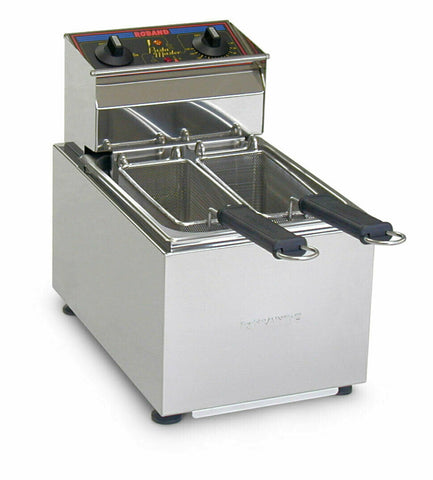

 Roband Pasta Master / Vegetable Blancher - MP18
275(W) X 425(D) X 340(H)mm


 Bottene PM35 Pasta Extruder - 898144
395W x 770D x 540Hmm


 B+S KNC-6 6 Basket Noodle Cooker - 873056
450W x 860D x 1080Hmm


 Stima CC2001/4 Pasta Machine - 862891
760W x 550D x 580Hmm

 Roband MP18 Pasta/Vegetable Blancher - 891094
275W x 630D x 390Hmm
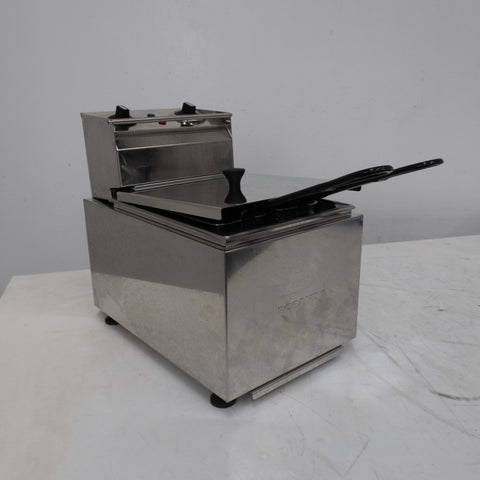
 Roband MP18 Pasta Cooker - 805476
270W x 420D x 290Hmm


 Luus YC-1 Yum Cha Steamer - 806577
760W x 955D x 1310Hmm
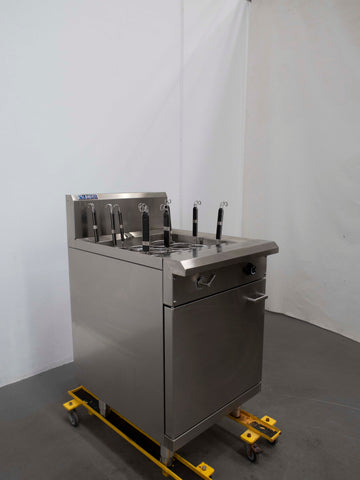
 Luus NC-60 Noodle Cooker - 873278
600W x 800D x 1110Hmm
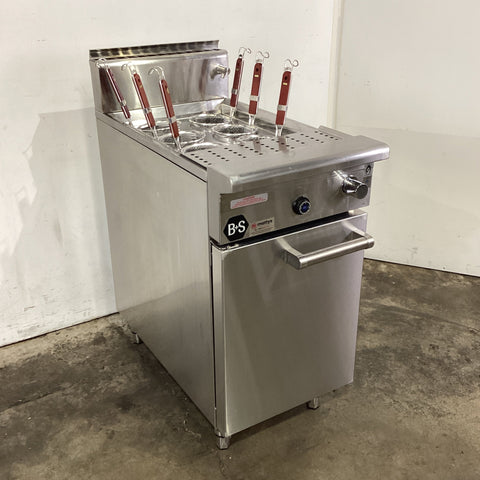
 B&S NC-6-NG Noodle Cooker - 862900
450W x 840D x 1040Hmm
Commercial benchtop pasta cookers sit on the bench and boil pasta, noodles, gnocchi and dumplings in baskets, so the cooking comes off the range and out of a stockpot. For a venue adding a pasta or noodle line without rebuilding the cookline, benchtop pasta cookers are usually the cheapest way to get there.
The range splits by energy source. Commercial gas pasta cookers are the default where there is already gas on the bench, electric pasta cookers suit sites with no gas run, and induction pasta cookers recover the boil best between baskets. The wider benchtop appliance range covers the rest of what sits on a bench.
Basket count, basket shape and the number of pasta portions you push through the busiest hour decide the model, not the headline size. Every model's figures are on its own product page and in our specifications information.
If you are not sure the bench, the gas point or the extraction will take one, request a callback and we will work through it with you before you order.
Gas heats a tank of water fastest and is the usual choice where the bench already has a gas point and a bayonet or hard line available. Electric installs anywhere with the right supply, which is the answer where there is no gas on the bench, or where the lease or the extraction makes adding gas impractical. Induction recovers the boil best between baskets, so it is worth a look if every order is cooked to order.
Both do the same job. The real question is what the site can supply. Check the connection and clearance figures on the product page for the model you are looking at, and compare them against what you have before committing.
Count the portions you plate in the busiest fifteen minutes, not the day. Each basket is one order in the water at a time, so a pasta section pushing orders back to back needs more baskets than a bistro serving two pasta dishes off a broader menu.
More baskets also means more flexibility, because you can hold different shapes and cook times side by side rather than queueing them. If you are running one sauce and one shape, fewer baskets will do.
It produces steam, and a lot of it, so it needs to sit somewhere the steam can be drawn away rather than condensing on the ceiling or into the servery. In most kitchens that means under the existing canopy on the cookline.
Whether your canopy covers the spot you have in mind is a site question, and it is the one most often missed when a benchtop unit is bought to go on a spare bench. If you want it checked before you order, request a callback.
A pasta cooker is built to hold water at the cooking point all service, with a basket lift, a drain and a water level that is managed rather than topped up by eye. A stockpot on a burner does the same job far more slowly and ties up a burner you need for sauces.
The other difference is consistency. Baskets mean every portion goes in and comes out on a timer rather than being fished out with tongs, which matters when one chef is plating pasta and firing griddle orders at the same time.
Drain and refill daily rather than topping up, because starch builds in the water and the pasta suffers for it before the machine does. The baskets, the lid and the element shroud come out for washing, and the drain gets flushed at the end of service.
Starch scale is the thing that shortens the life of these units. Follow the cleaning and descaling schedule in the model's own documentation, and keep the drain clear so you are not working around a unit that will not empty.
Yes, and most kitchens do. Noodles, dumplings, gnocchi, blanched vegetables and reheated portioned sauces in bags all go through the baskets. A pasta cooker is effectively a controlled water bath with a basket lift, which is why it ends up in Asian kitchens as often as Italian ones.
For sous vide work in sealed bags, dedicated sous vide circulators hold a lower, tighter temperature and are the better tool. Keep blanched product moving into refrigeration quickly, and plan bench space for gastronorm containers on the way out.
Next to the plating bench, with the drain within reach of a floor waste and the water point close enough to refill without walking the kitchen. It is a wet, hot appliance, so it wants solid support under it rather than a shelf.
A run of stainless steel bench rated for the load is the usual answer, with a landing zone on the pass side for bowls and kitchen utensils. Keep the clearances the product page asks for on every side, especially behind a gas model.

We have a special page just for stock that's warehoused in Perth.
Click Here to see all WA stockWhat our customers say about us on Google, and how Google scores our store for things like shipping and returns.
Store scores from Google