


 03 9070 5784
 Help & Support
 Track My Order



Recently Viewed

 Yasaki Cheese Grater Chopper AK55C
405(W) x 240(D) x 430(H)mm

 Nemco Easy Cheeser 3/4 X 3/8" 18mm X 9mm - NCC0003
318(W) x 336(H) x 172(D)mm
 Nemco Easy Cheeser Mozzarella 5/16" 8mm - NCC0004
318(W) x 101(H) x 165(D)mm
 Nemco Easy Cheeser 3/4" 18mm - NCC0002
318(W) x 336(H) x 172(D)mm
 Yasaki Cheese Grater Chopper AK90C
600(W) x 240(D) x 510(H)mm

Commercial manual cheese slicers cut blocks and wheels cleanly without a motor, and they come in two quite different forms. A wire cutter draws a tensioned wire through soft and semi-hard cheese; a lever or roller slicer presses a blade through a block to a set thickness. Which of the two you want is decided by the cheese you cut, not by the price.
Wire is the answer for anything that drags on a blade — brie, blue, fresh mozzarella, soft washed rinds — because the wire parts the cheese rather than smearing it. A blade slicer is faster and more consistent on firm cheddar, tasty and haloumi, where the block holds its shape under pressure.
They sit in the manual kitchen appliance range and are often bought alongside meat slicers for a deli counter and bread slicers for the sandwich bar.
Fitting out a deli counter or replacing worn units across several sites? Send the list and get a quote.
Wire for soft and sticky cheese, blade for firm cheese. A wire passes through brie or blue without compressing it, where a blade will drag the paste and leave a smeared face that will not sell.
Blade slicers are faster and give a more repeatable thickness on cheddar-style blocks, which matters when portions are being weighed to a price. Delis handling both styles of cheese usually own one of each rather than compromising on one.
Because cheese behaves differently from smallgoods on a rotating blade. Fat softens against a spinning blade, the slice sticks to the plate and the machine ends up smeared rather than cutting. Hard, aged cheese slices acceptably; soft cheese does not.
A manual slicer gives control over pressure and speed, which is what soft cheese needs. If you are mainly cutting smallgoods and only occasionally cheese, our meat slicer range is the better place to start.
As often as it needs it, which is a function of how much cheese you cut and how hard it is, not a schedule. A wire that has stretched pulls off line and leaves a sloped face, and that is the signal to change it.
Buy a model with readily available replacement wires and keep spares on hand, because a wire goes mid-service rather than conveniently. Check what the manufacturer supplies for your model before you commit.
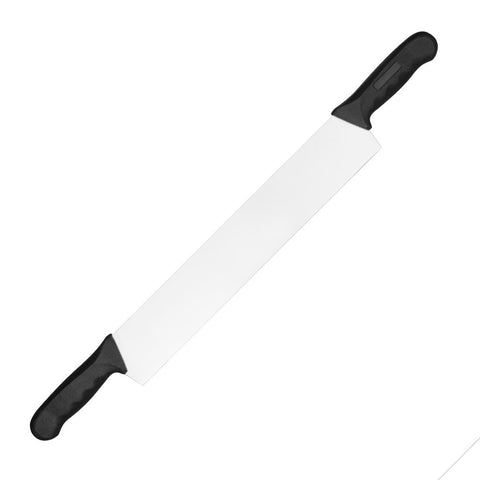
Only with a cutter built for it. Wheel cutters are a different tool from block slicers: they use a longer wire or a double-handled blade and often a marked plate for even wedges. A block slicer will not take a wheel.
If wheels are part of the offer, decide how you want them divided before you buy the tool. A wooden serving board and a set of wires covers a cheese room; a counter cutting to order needs the dedicated unit.
Broken down and washed after every use, because cheese fat sets on steel and on wire and holds onto whatever it picks up next. The base plate, the blade or wire, the frame and the pusher all come apart on any slicer worth buying.
Food-contact surfaces should be 304 stainless steel, the food-safety grade in Australia, which tolerates daily washing without pitting. Use a dedicated chopping board for cheese and keep it away from raw product, and keep the cheese knives with the slicer rather than in the general drawer.
On a solid bench within reach of the deli display fridge the cheese comes out of, with a clear landing space for the cut product. Cheese needs to come out cold and go back cold, so a long walk between the fridge and the slicer costs you quality.
Leave room for scales and wrapping on the serve side, and keep the cut face of a block covered between orders. Finished portions go onto serving trays or straight into the display rather than sitting on the bench.

We have a special page just for stock that's warehoused in Perth.
Click Here to see all WA stockWhat our customers say about us on Google, and how Google scores our store for things like shipping and returns.
Store scores from Google
