


 03 9070 5784
 Help & Support
 Track My Order



Recently Viewed
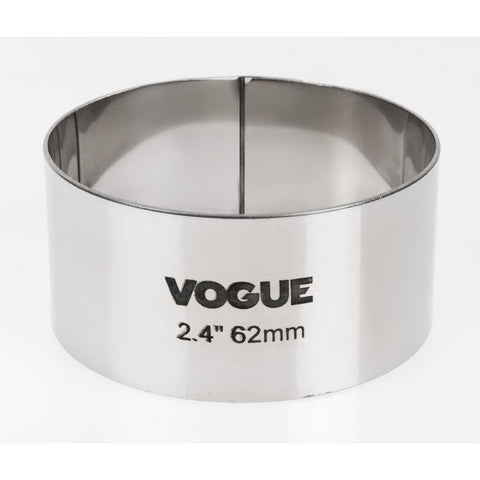


 Vogue Mousse Ring 35 x 90mm - CC057
90(W) x 35(H) x 90(D)mm

 Vogue Mousse Ring 60 x 90mm - CC058
90(W) x 60(H) x 90(D)mm

 Vogue Mousse Ring 60 x 70mm - CC056
70(W) x 60(H) x 70(D)mm


 Vogue Non-Stick Dariole Moulds 65mm - GC981
65(W) x 60(H) x 65(D)mm
Stainless steel dariole moulds, rings and timbales are the moulds a kitchen buys when it wants the same shape out of the oven every service. Steel conducts heat quickly, holds its shape under load and does not stain or absorb flavours.
The decisions are shape, depth and how the mould releases. Straight-sided rings hold a tart shell upright; tapered dariole moulds turn out cleanly; deeper moulds suit set desserts and terrines. 304 stainless steel is the food-safety grade used in Australian commercial kitchens, and it is the grade to look for on anything in constant contact with acidic food.
Steel moulds sit in the kitchen moulds range next to silicone food moulds and aluminium food moulds, and they are used alongside baking trays and quiche tins, so you can start with the shapes the menu needs now and add more as your business grows.
Putting a pastry section together? The price guide lists the ring and dariole sizes with prices, so you can buy multiples of the shape the menu runs and singles of the rest.
Steel holds a sharp edge on the finished product and survives being knocked around in a commercial wash. Silicone flexes, which makes release easy but softens the definition of the shape, and it needs a tray under it. Aluminium conducts heat faster but marks and reacts with acidic fillings.
Most pastry sections carry a mix: steel for rings and set desserts, silicone for anything awkward to turn out, and aluminium for high-volume disposable-style work.
Grease and line properly, and chill the product before you turn it out. Steel does not flex, so the release comes entirely from the surface preparation and the temperature of the contents, not from the mould bending.
A thin film of butter and a dusting of flour or sugar is enough for baked work. For set desserts, a brief dip in warm water loosens the edge. A pastry brush gives you a more even film than a cloth.
Good-grade stainless resists corrosion, but it is not immune. Rust spots almost always come from something else: steel wool left on the surface, contact with carbon-steel tools in the same tub, or salt residue left to dry in a seam.
Wash, rinse and dry rather than leaving them wet in a stack. Keep them away from steel wool and use the pads from the cleaning supplies range that are rated for stainless.
Steel moves between hot and cold work without complaint, which is the main practical advantage over plastic. The same ring can bake a tart shell and then set a mousse, which is why pastry sections standardise on it.
Check the product page specifications for anything you intend to put under a grill or salamander, and remember that a steel mould straight out of a blast chiller will sweat.
Hold multiples of the one size your menu uses constantly, and singles of the rest. A section with a few of every shape and multiples of none cannot plate a full service of anything, which is the usual mistake on a first order.
Count the mould against the tray it sits on. If your moulds do not fit a sensible grid on your baking trays or oven racks, you lose oven space on every bake.
Soak to loosen baked-on sugar, wash, then rinse and dry. Sugar carbonises into a hard film that scouring will scratch, so soaking does the work that scrubbing cannot.
Most go through a commercial dishwasher, and anything with a rolled edge should be stood on its side so water drains out of the seam rather than sitting in it.
Mould sizes vary by maker and by shape, and the usable capacity is often less than the stated volume once you allow headroom. Take the figures from the product page specifications for the item rather than from a generic size chart.
If you are matching new moulds to existing recipes, measure what your current mould actually holds and compare that figure rather than the shape name.
Dariole moulds, timbale moulds, pudding moulds, food rings, presentation rings and plating rings all describe closely related items. The difference that matters is whether the mould has a base.
Rings with no base are used on a tray or plate for plating and for tart shells; closed moulds are for anything poured and turned out. The egg poachers, cutters and rings and kitchen utensils ranges cover the open-ring end of it.

We have a special page just for stock that's warehoused in Perth.
Click Here to see all WA stockWhat our customers say about us on Google, and how Google scores our store for things like shipping and returns.
Store scores from Google