


 03 9070 5784
 Help & Support
 Track My Order



Recently Viewed
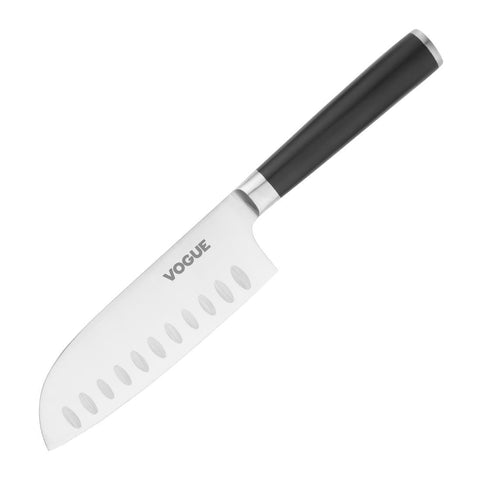

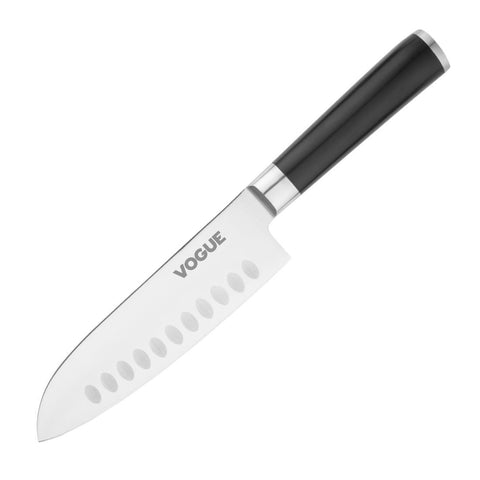

 Vogue Bistro Santoku Knife 180mm - FS686
305(W) x 50(H) x 5(D)mm
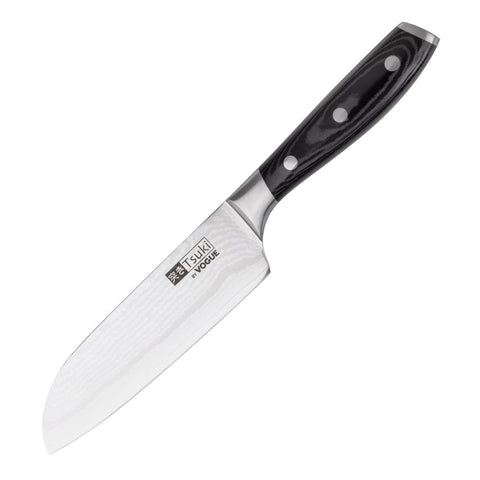
 Vogue Tsuki Series 7 Santoku Knife Black 175mm - CF844
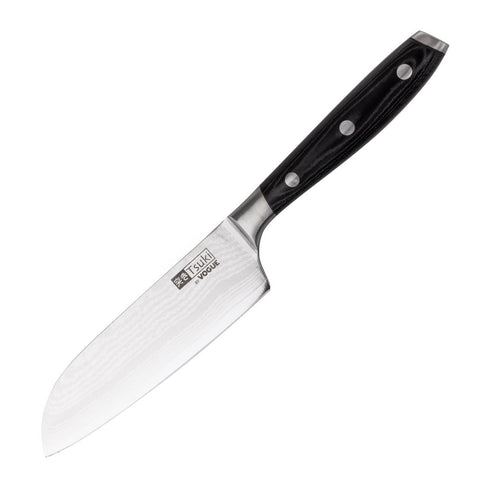
 Vogue Tsuki Series 7 Santoku Knife Black 14.3cm - CF845
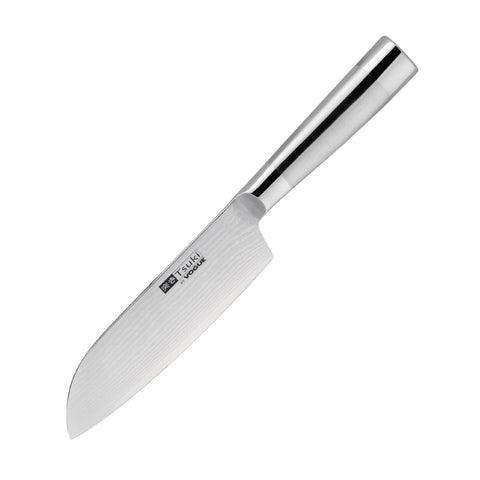
 Vogue Tsuki Series 8 Santoku Knife 140cm - DA444
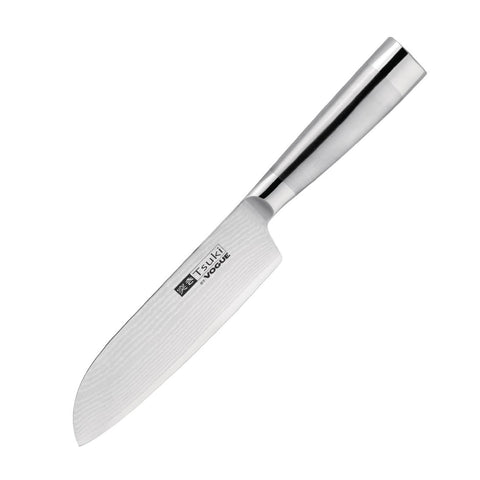
 Vogue Tsuki Series 8 Santoku Knife 175mm - DA441
A santoku knife is the general purpose blade on a prep bench: slicing, dicing and cutting thin, worked with a push cut straight down rather than a rocking motion. Santoku knives are the Japanese version of that knife, shorter and taller than a European chef's knife, with a flatter edge and a thinner grind, and the flat edge is what the push cut is for.
The tall blade gives knuckle clearance and acts as a scoop to move product off the board. The thin grind is what gives the fine slice, and it is also the trade-off: a commercial santoku knife is less tolerant of bone, frozen product and being thrown in a sink than a heavier European blade.
Most of them carry scalloped hollows along the blade, which break the suction that makes potato and cucumber stick. A professional santoku knife sits beside a chef's knife rather than replacing it, for the work that wants precision.
Comparing blade lengths before a section gets one? The price guide shows the santokus next to the chef's knives and cleavers, so you can see what each bench is worth spending on.
Length, profile and grind. A santoku is shorter, taller and flatter along the edge, and it is ground thinner. A chef knife has a curved belly made for rocking and more steel behind the edge.
In practice a santoku cuts more precisely and a chef's knife handles more abuse. Most commercial kitchens keep both.
Straight down, or down and slightly forward. Rocking a santoku the way you would rock a chef's knife wastes the flat edge and leaves the last centimetre uncut.
The board matters with a push cut. Use a board with some give from the chopping board range rather than a hard surface.
They break the vacuum that forms between a wet slice and a flat blade, so potato, cucumber and cheese fall away instead of clinging. The effect is real but modest.
They are not a sharpness feature and they do not make the knife lighter in any meaningful way. Buy on steel and grind first.
No. The thin, hard edge chips, and a chip in a hard blade means a re-grind rather than a quick hone. Bone work wants a cleaver or a heavy chef's knife.
Frozen product is the same problem. Thaw it or use the right tool from the meat and seafood utensils range.
On a stone at the narrower angle it was ground to, or by a service that knows Japanese blades. A powered wheel set for a European angle will take the fine edge off it permanently.
A fine ceramic rod suits daily honing better than a coarse steel. See the sharpeners range for what suits a hard thin blade.
Stainless santokus will not in normal use. Some Japanese blades are laminated with a high-carbon core, and those will spot if left wet, so check what the blade is made of before buying.
304 stainless steel is the food-safety grade used in Australian commercial kitchens, and a harder stainless alloy holds an edge well enough for this style of knife.
On a faced wall rack, in a slot, or in a knife case — never loose, because the thin edge chips against other steel.
It is also the blade most worth protecting in a shared kitchen. The knife storage range covers the options.

We have a special page just for stock that's warehoused in Perth.
Click Here to see all WA stockWhat our customers say about us on Google, and how Google scores our store for things like shipping and returns.
Store scores from Google