


 03 9070 5784
 Help & Support
 Track My Order



Recently Viewed
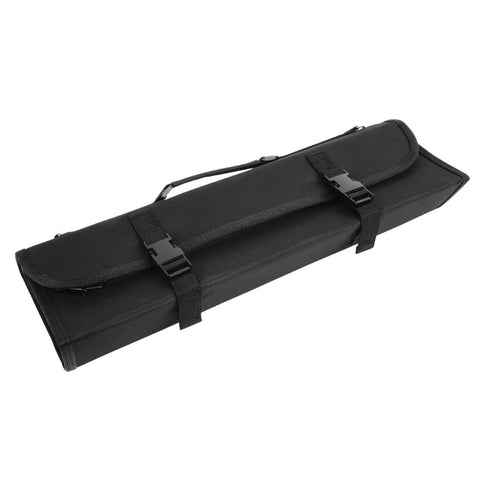

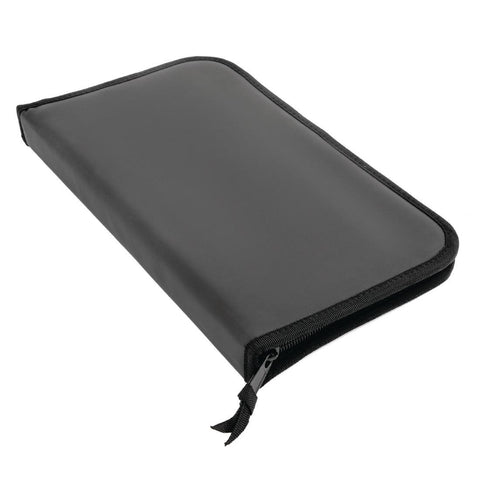

 Vogue 7 Compartment Knife Case - GD049
240(W) x 370(H) x 30(D)mm
Knife cases carry a chef's own blades between sites and get them there sharp, which is something a block on the bench cannot do. A roll or a hard case holds each knife separately so edges do not touch, and that is the difference between knives that last and knives that need re-grinding every month.
Soft rolls are light, take odd shapes and pack flat. Hard cases protect better if they are carried on a bike or thrown in a van, and they usually lock. Some suppliers list the category as knive cases.
The case is also the practical answer to knives walking out of a kitchen, because a set in a locked case belongs to someone. House blades stay in a knife block or on a wall rack; personal ones live in the case.
Buying cases for a brigade or a culinary school rather than one chef? Slot counts and case prices are set out in the price guide.
A roll is lighter, cheaper and takes mismatched blade lengths. A hard case protects against crushing, holds its shape in a bag and generally locks.
If the knives travel daily, buy the hard case. If they move occasionally between two sites, a roll is enough. The rest of the knife storage range covers the fixed-bench options.
Enough for the knives you carry plus a steel, a peeler and a spare slot. Buying tight means the next knife ends up loose in a bag.
Slot counts are listed per product. If you carry long blades — a bread knife or a slicer — check the slot length rather than only the count.
It stops them being blunted, which is most of the battle. Edges dull faster from knocking against other steel in transit than from cutting.
It does not sharpen anything. A steel or a pocket sharpener from the sharpeners range belongs in the case.
Only if they go in clean and dry. A blade put away damp sits against fabric in a closed case, and that is how stainless ends up spotted.
Dry each blade, close the roll loosely rather than cinched tight, and keep the case somewhere ventilated. Not in a locker beside the dishwasher where it gets steam.
Most fabric rolls can be wiped out and some can be washed, and the listing will say which. Hard cases wipe clean with a mild detergent from the surface cleaners range.
Empty it and clean it on a schedule. A case that has never been emptied holds crumb and fat in the bottom of every slot.
Carrying tools of trade to and from work is normal, and a closed, secured case is how you demonstrate that. Loose blades in a backpack are not.
Keep the case closed in transit and out of sight. Common sense rather than a legal opinion, but it is what the case is for.
A chef's knife, a paring knife, a serrated blade, a santoku or utility blade, a steel, a peeler and tweezers. Beyond that it depends entirely on the menu.
Buy the case to fit the knives you carry, not the other way round. The commercial knives range covers the blades.

We have a special page just for stock that's warehoused in Perth.
Click Here to see all WA stockWhat our customers say about us on Google, and how Google scores our store for things like shipping and returns.
Store scores from Google