


 03 9070 5784
 Help & Support
 Track My Order



Recently Viewed
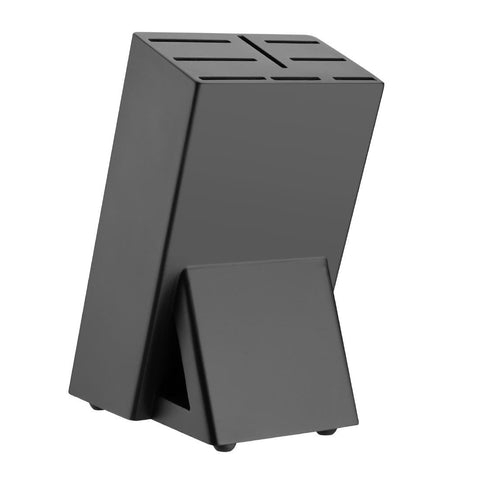

 Vogue Tsuki Black Wooden Knife Block - FS662
155(W) x 235(H) x 132(D)mm
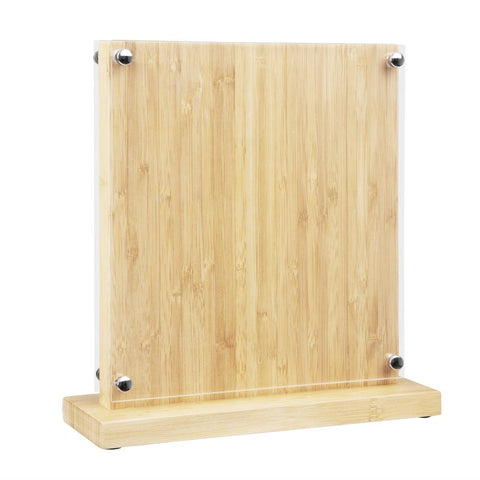
 Vogue Wood Acrylic Magnetic Knife Block - FS663
270(W) x 290(H) x 120(D)mm
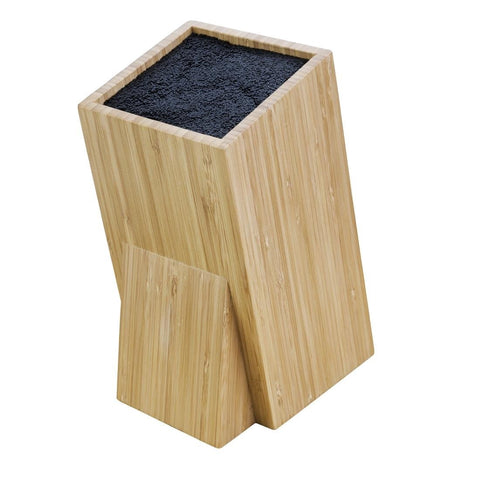
 Vogue Wooden Universal Knife Block - CP862
120(W) x 245(H) x 155(D)mm
A knife block keeps a station's knives on the bench, within reach of the board and with every edge protected, instead of loose in a drawer. Knife blocks come as slotted, universal-bristle or magnetic designs and the three behave quite differently in a commercial kitchen.
Slotted knive blocks hold specific knives in specific places, which makes a missing blade obvious. Universal blocks take any shape, which suits a mixed set of knives. Magnetic blocks hold the blade on the outside, so nothing is trapped where it cannot dry.
In a commercial setting the deciding factor is usually cleaning. A slot you cannot see into and cannot dry is the weak point, which is why many kitchens prefer a wall rack or a magnetic block over a traditional slotted one.
Comparing a block against a wall rack for each bench? The price guide prices the knife blocks and the racks together.
Slotted gives each knife its own place and shows a gap when one is missing. Universal takes whatever you own, including odd-length blades. Magnetic holds blades on the outside where they dry and can be wiped.
For a commercial kitchen the magnetic and universal designs are easier to keep clean. Slotted suits a bakery or pastry bench with a fixed set — see pastry knives for that section.
That is the main objection to them. Slots trap crumb and moisture and are hard to inspect, so a block needs emptying and drying on a schedule rather than being treated as furniture.
Universal-bristle blocks can usually be emptied and washed, and the listing will say what is possible. Keep the block away from the pot sink splash zone so it is not permanently damp.
Timber is kinder to edges and looks right front of house, and it needs hand care. Stainless and composite are easier to sanitise, which is why they dominate in production kitchens.
304 stainless steel is the food-safety grade used in Australian commercial kitchens. Materials are listed per product and on specifications.
Only as many as the station actually uses. A block with eight slots and four knives in it looks like something is missing; a block with four slots and four knives is a working tool.
If you want the knives and the block in one purchase, the knife sets range usually pairs them.
A slot lined with timber or bristles does not. A hard plastic slot that the edge drags across every time will, slowly.
Insert spine-down where the design allows and keep a steel beside the block so honing is part of putting the knife away.
Within reach of the board, back from the edge, and clear of the cooking line so it is not in splatter range of a griddle or fryer. Fat on a block is hard to remove.
It should not sit where it can be knocked into a sink or onto a foot. Bench space is the real cost of a block, which is the argument for a wall rack instead.
Only if they stay on site. A chef who moves between venues wants a knife case instead, and mixing personal blades into a house block is how knives get lost.
Keep house knives in the block and personal ones in a case. The rest of the knife storage range covers both.

We have a special page just for stock that's warehoused in Perth.
Click Here to see all WA stockWhat our customers say about us on Google, and how Google scores our store for things like shipping and returns.
Store scores from Google