


 03 9070 5784
 Help & Support
 Track My Order



Recently Viewed
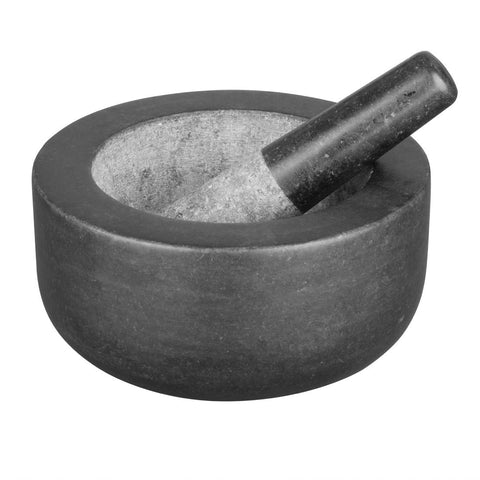


 Vogue Porcelain Pestle and Mortar 115mm - J923
115(W) x 50(H) x 115(D)mm
A commercial mortar and pestle crushes spices, herbs and aromatics instead of cutting them, which releases the oils rather than bruising and heating them. For a curry paste or a fresh spice blend ground to order, that is the difference in the dish.
Material decides the behaviour entirely. Granite is heavy, rough-surfaced and grips a hard spice, which is why a professional mortar and pestle for paste work is usually granite. Marble is smoother and better for soft herbs and emulsions. Ceramic and porcelain suit dry spices but chip under heavy work. A professional pestle and mortar in brass or cast iron is used for pounding rather than grinding.
Size is the other decision, and most kitchens buy too small. A mortar that is too shallow throws spice out, and one too small means working in batches. Keep it with the kitchen scales and salt, pepper and vinegar pots on the prep bench, and see commercial stick blenders for the powered alternative.
Granite, marble or ceramic, and in what size? The price guide prices the materials against each other, so going a size up is a decision you can cost.
Granite for anything hard or fibrous: spices, lemongrass, galangal, nuts. The rough interior is what does the grinding. Marble for herbs, garlic and emulsions, where you want a smooth surface that does not stain.
Ceramic is for dry spices in small amounts and will chip if used like granite. If the kitchen does one style of cooking, buy for it rather than compromising — see commercial kitchen tools for the lighter alternatives.
A granite one does. Grinding rice, then salt, then discarding both removes loose grit from the surface before food goes near it, and it is worth doing twice on a rough new mortar.
Marble and ceramic do not need it. Wash, dry and use — see product documents for anything the supplier provides on it.
A blade cuts and generates heat, which drives off the volatile oils you are trying to release. Crushing ruptures the cells and keeps the oil in the paste.
For volume, a blender is the practical answer and the quality cost is real. A commercial bar blender or a stick blender handles the batch work.
Bigger than it feels like it needs. A mortar is used to about half its depth before material starts leaving it, so the usable capacity is much less than the bowl suggests.
Capacity is on each product page. If the kitchen makes paste daily, buy the largest one someone can lift onto the bench — then leave it there. A stainless steel bench can take the weight.
Water and a brush for granite, because porous stone holds detergent and then releases it into the next paste. For stubborn residue, grind coarse salt and rinse.
Marble and ceramic can take detergent. Nothing in this category goes in a commercial dishwasher — the weight damages racks and the thermal shock cracks stone.
Granite holds a little colour from turmeric and chilli and does not hold flavour if cleaned properly. Marble stains more visibly from acids.
If sweet and savoury work both happen, hold two. They are durable enough that a second one is a one-off purchase — see pastry and baking supplies for the sweet-side equivalents.
On the bench where it is used, with the pestle inside it. It is too heavy to be moved regularly and it will damage anything it is stored on top of.
If it must be stored, low and on a solid shelf — see modular shelving rather than a wall shelf.

We have a special page just for stock that's warehoused in Perth.
Click Here to see all WA stockWhat our customers say about us on Google, and how Google scores our store for things like shipping and returns.
Store scores from Google