


 03 9070 5784
 Help & Support
 Track My Order



Recently Viewed

 Hygiplas Colour Coded Wall Chart with Allergens - FY214
210(W) x 295(H) x 5(D)mm



 Vogue Stainless Steel Staff Only Door Sign - U060
75(W) x 5(H) x 75(D)mm
 Vogue Stainless Steel Push Door Sign - U063
75(W) x 5(H) x 75(D)mm

 Vogue Stainless Steel Open & Closed Door Sign - U065
130(W) x 210(H) x 130(D)mm
 Vogue No Smoking Door Sign 75mm - U052
75(W) x 5(H) x 75(D)mm


 Jantex Cone Wet Floor Safety Sign - L483
280(W) x 680(H) x 280(D)mm


 Carlisle Yellow with grey cone casing Pop-Up Caution Cone 510mmH - 3694204
 Carlisle Yellow Caution Cone 915mmH x 317mm Base width - 3694104

 San Jamar Allergen Safe-T-Zone System in Purple - ASZ121812SYS
Kitchen safety signs tell staff what to do at the spot where they do it: wash your hands at this basin, wear gloves at this station, this surface is hot, this floor is wet. They are also the easiest thing in a kitchen to get wrong, because a sign nobody can read from where they stand is decoration.
Commercial kitchen safety signs fall into a few groups: hazard warnings on equipment, PPE requirements at a station, hand washing at the basin, and wet floor signs that move with the mop. The first three are fixed; the last one is a consumable.
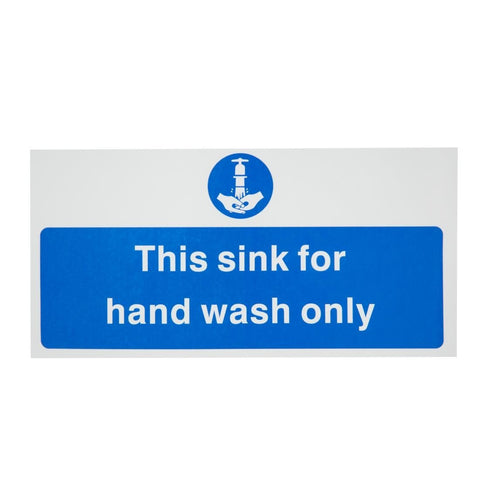
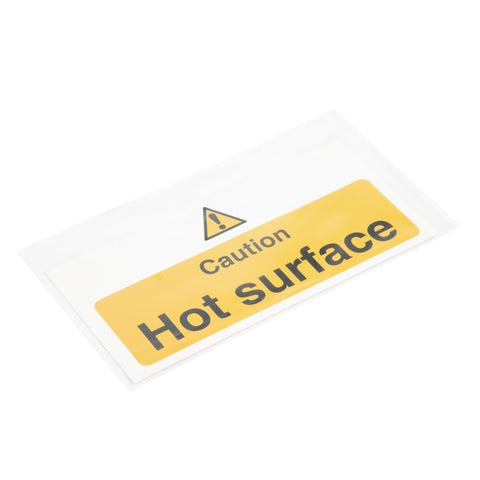
Signage works with the fittings it refers to. A hand wash sign belongs above the hand wash basin, a hot surface warning near the deep fryer, and a wet floor sign in the mop bucket store. You can start with the areas that need covering now and add more as your business grows.
Working out the signage list for a fit-out? The price guide prices the fixed signs and the wet floor signs together.
Requirements are set by your state's work health and safety regulator and your local council's food safety rules, so the definitive list comes from them rather than from a supplier.
In practice almost every kitchen carries hand washing at the basin, PPE where it is required, hazard warnings on hot and moving equipment, and chemical warnings at the cleaning supplies store.
Directly above the basin, at eye level for the shortest person who uses it, and nowhere else. A hand washing sign on a general noticeboard is doing nothing.
Pair it with soap and a towel that actually work — see hand soaps and sanitisers and paper towel and dispensers. A sign over an empty dispenser is worse than no sign.
Rigid plastic or stainless for anything permanent in a wet or hot area, because paper and self-adhesive vinyl lift once steam gets behind them. Stainless suits a visible front-of-house position.
Avoid printing and laminating your own for permanent positions. They look temporary within a month, which is exactly the impression an inspection does not need.
Where part of the team reads another language more comfortably, yes in practice, regardless of what is strictly required. A safety sign only works if it is understood at a glance.
Pictogram-led signs solve most of it without translation, which is why hazard symbols are standardised. Use words as the backup, not the main message.
Yes, and they are the one item in the category that gets used daily rather than installed once. Treat them as cleaning equipment and store them with the mops and brushes.
Two per cleaning round is the usual minimum: one at each approach. A single sign in the middle of a spill warns nobody arriving from the other side.
Keep the number down. A wall of twenty signs is read as wallpaper; four signs in the right places are read as instructions.
Site each one where the action happens rather than at the entrance, and replace anything faded or peeling. The same logic applies to kitchen food labels on the shelf.
Where chemicals are decanted or stored, yes, and the safety data sheets have to be accessible to staff. The supplier provides those with the product.
Keep the chemical store signed, locked where it should be, and separate from food. See disinfectant and sanitisers and dishwashing chemicals.

We have a special page just for stock that's warehoused in Perth.
Click Here to see all WA stockWhat our customers say about us on Google, and how Google scores our store for things like shipping and returns.
Store scores from Google