


 03 9070 5784
 Help & Support
 Track My Order



Recently Viewed
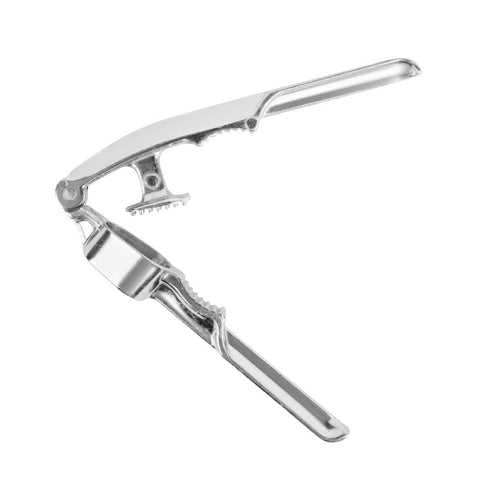

A commercial garlic press crushes cloves straight into the pan, the marinade or the mix, so a kitchen that gets through garlic by the kilo is not standing at a board chopping it. The result is the same every time, which hand-chopped garlic never is. A garlic crusher is the same tool under a different name.
What to compare is how much it holds, how it feels in the hand after the fiftieth clove and whether it comes apart. A press that does not separate cannot be properly cleaned, which in a garlic tool matters more than usual.
Where the volume goes past what any press can handle, the answer is a machine rather than a better press — see veg prep machines and manual veg prep machines. The full hand-tool range is in commercial kitchen tools.
Comparing presses before you commit a prep station to one? Ask for the price guide and check the bodies and the basket designs side by side.
Listings use press and crusher interchangeably, so a commercial garlic crusher and a commercial garlic press are the same tool. For a few cloves, a knife is faster. For a few hundred, a press wins because it does not require skill or attention and the output is identical every time.
Past that point neither works and you want a machine or pre-prepared garlic. A mortar and pestle is the other option where you want paste with salt rather than crushed garlic.
In a commercial kitchen, effectively yes. Garlic residue dries hard in the holes and a press that cannot be opened keeps that residue between uses.
A hinged press with a swing-out basket is the standard answer. Check it against a commercial dishwasher cycle on the product page before you rely on the machine for it.
Most commercial presses will take an unpeeled clove and hold the skin back in the chamber, which is the main speed gain over a knife. The skin then has to be cleared before the next clove.
Peeling first gives a cleaner yield and less clearing, so high-volume kitchens usually peel a batch and then press. It is a trade between two kinds of handling.
A heavy cast body lets you crush a clove with less effort, which is what makes a press easy to use over and over, and it is why many are cast rather than pressed. Stainless is the easiest to keep clean and 304 stainless steel is the food-safety grade used in Australian kitchens.
Avoid anything with a painted or coated body, because garlic acid and a dishwasher together will lift a coating. See stainless steel kitchen accessories for the alternatives.
Wash it immediately rather than at the end of service, because the smell comes from residue in the holes that has had time to dry. A soak and a brush gets what rinsing will not.
Keep it as a garlic-only tool. Trying to use the same press for ginger and then for garlic transfers both ways — see fruit preparation tools for the dedicated alternatives.
Ginger is fibrous and will clog a press designed for garlic, and the fibres are what jam the hinge. Shallots work; ginger usually does not.
For ginger, a fine grater or a blender is the better tool. See commercial stick blenders for pastes in volume.
One per station that uses garlic constantly, and a spare, because a jammed hinge in the middle of prep is the common failure. They are cheap enough that a spare is not a decision.
Store them with the station's other tools rather than in a shared drawer — see cutlery storage.

We have a special page just for stock that's warehoused in Perth.
Click Here to see all WA stockWhat our customers say about us on Google, and how Google scores our store for things like shipping and returns.
Store scores from Google
